I need to get out more. Though I have a degree that requires me to be within sight of the ocean or risk being irrelevant, I really don't spend as much time as I should on the beach or in the ocean. I could blame the land-based job, the abiologist friends, or the lack of Ariels actually in the sea.
You mean being a marine biologist isn't a guarantee of meeting hot ichthy-chicks with bivalve-bikinis who want to be part of my world ? Damn you Disney!
But it's probably due to the certain complacency that comes with coasting after a long slog in Academia. Unfortunately, like the French and the Maginot Line, complacency ultimately leads to Enigma Nazis trampling through your Ardennes Forest of Hubris until the Allied Powers of Science storm the beaches to rub your face in your own failure. OK, so the analogy isn't perfect, but here is the story of how a simple question circumvented traditional defenses and laid waste to a presumptuous front-line of scientific stagnation.
While I may know a fair amount about what's going on in the ocean at any given time thanks to study, experience, and weekends, I'm still inside, at work, in an aquarium, most of the week. No matter the tides, the swell, the perfect conditions; if it's happening outside, I'm probably not there.
Visitors to the aquarium, however, have no such restrictions. Apparently carefree, jobless and loaded, they not only have hundreds of dollars to drop on the minivan of admission-paying, plush-buying, food-needing humanoids in the party, but they're free to roam the Earth, unfettered by material limitations. Trips to the beach, stops at the aquarium to use the restroom (I assume, based on their most frequent line of questioning), then off they go to the next national monument and week of wanton touristing, driving away into the sun presumably to see where it sets. Get a job, Hippies!
The combined amount of weekends and accumulated day-offs that come through the doors amount to (conservatively) several thousand occasions to see cool stuff that I don't get. This is depressing. I wish I were thousands of people's days off. Thankfully, most of these people have no idea what the hell they're looking at. This is depressing, but at least I get to have a false sense of superiority about it.
Visitors to the aquarium, however, have no such restrictions. Apparently carefree, jobless and loaded, they not only have hundreds of dollars to drop on the minivan of admission-paying, plush-buying, food-needing humanoids in the party, but they're free to roam the Earth, unfettered by material limitations. Trips to the beach, stops at the aquarium to use the restroom (I assume, based on their most frequent line of questioning), then off they go to the next national monument and week of wanton touristing, driving away into the sun presumably to see where it sets. Get a job, Hippies!
The combined amount of weekends and accumulated day-offs that come through the doors amount to (conservatively) several thousand occasions to see cool stuff that I don't get. This is depressing. I wish I were thousands of people's days off. Thankfully, most of these people have no idea what the hell they're looking at. This is depressing, but at least I get to have a false sense of superiority about it.
Oh, you're taking a break from building homes with your bare hands to come and learn more about marine life, and you don't know if you saw a seal or a sea lion? Your life has been wasted, and I will not let your ignorance of the stuff I happened to learn instead of what you learned rub off on me. Adieu.
Often the questions I get at work are softball, mildly endearing, and retrospectively preposterous for this reason. Not only do visitors not know what they're looking at, but many don't have any preconceived notions of what makes sense to ask. It's like asking Bill Nye if his bow-tie helps him science better; I'd love to know the answer, but you can only come up with that question if you have no notion of the absurdity of the inquiry. Though, with Bill Nye, Alton Brown, and Pee Wee Herman on the bow-tie bandwagon, bow-ties must hold magical powers; or perhaps each of them is a metaphysical projection representing the intellectual, gustatory, and comedic facets, respectively, of a bow-tied poltergeist. But I digress.
With no sense of the multitude of lines of questioning available to them, most people try get the low-hanging fruit out of the way to see what's left. We all do this. It's exactly what I do when trying to figure out why my theoretical girlfriend is mad at me. Start simple, see where that leads, then ask the hard-hitting question I really should have been asking all along but didn't know I should.
With no sense of the multitude of lines of questioning available to them, most people try get the low-hanging fruit out of the way to see what's left. We all do this. It's exactly what I do when trying to figure out why my theoretical girlfriend is mad at me. Start simple, see where that leads, then ask the hard-hitting question I really should have been asking all along but didn't know I should.
"Hey babe, how was your day? Good? Cool. You're not smiling, is everything OK? Alright, that was an obvious question, I'm sor... What? No no, you don't always have to smile, I just... Look, I was just, I don't know... WHAT CAN I DO RIGHT NOW TO ALLEVIATE THE SITUATION WITHOUT YOU HAVING TO TELL ME WHAT TO DO?"
Because people tend to start small, I will typically direct the conversation towards topics that I think they would want to know more about. This transaction is usually mutually beneficial. There has been a diffusion of information along the marine-knowledge concentration gradient from aquarium staff to aquarium visitor. The guest learns something, the interaction is more or less efficiently conducted, and my paycheck is justified.
In this manner, the occurrence of new questions steadily decreases, the topics of discussion solidify, and the period between unknown answers increases; your intellectual self then grows soft, comfortable, fat*.
And that's when you're called to identify a piece of beach-wrack. Confidence abounds. Bets are taken. Accolades are made preemptively about the imminent resolution of a simple identity crisis. In the haze of internal self-glorification, the dark movements within a forgotten territory go unnoticed.
Your Maginot Line of Complacency, built up over the years from repeated if now-historical victories, has made you forget about the Ardennes Forest of Hubris. An imposing obstacle to most adversaries, it remains unprotected from a smart question composed on the seashore you rarely frequent. Weeks of new things have come and gone, washed on shore and back out to sea, and you weren't there to see any of it. But these people, they were just on the beach, sand probably still stuck between their toes, like so much ocean's foot you once wore with pride that was snuffed out by uniform shoes.
You may be unprepared for this. This somber realization tries to slip from out of your now-insecure subconscious to the overconfident conscious, but it is delayed navigating the understory of your pride. You march on without a clue of the impending calamity.
As you introduce yourself as "Mr. Marine Biologist" to the little girl, you suddenly feel a slight twitch along your flank; a shadow of a doubt in the understory could feasibly cause this sensation, but you suppress the feeling. There is no way the child in front of you could ask you a question that should disarm you completely and effortlessly. A direct attack would be foolhardy. Unfathomable. No one in their right mind could tackle the wall of interpretive ammunition you have at your disposal with a simple question of identification. It's probably some tunicate, or a sponge, or some Styrofoam; it always is.
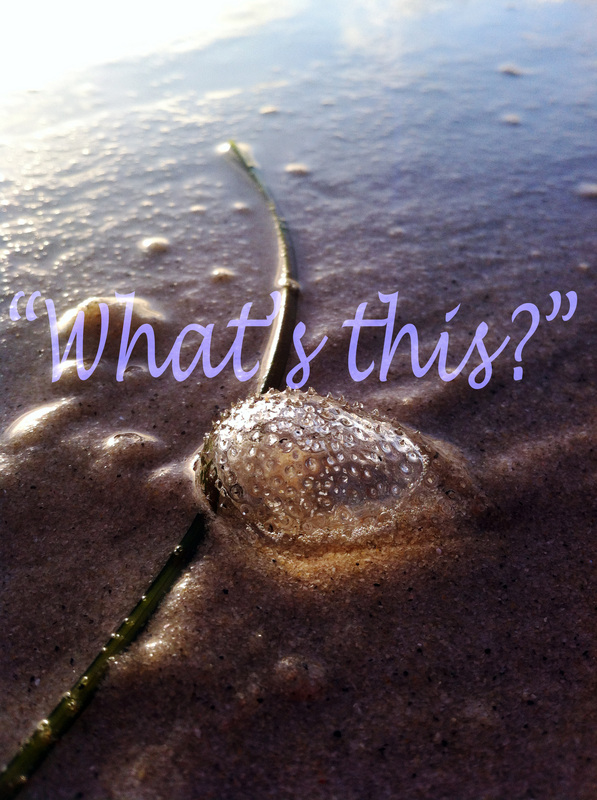
With a nearly imperceptible je ne sais quoi of unease in the back of your head, and muffled shouts from the underbrush of your mind, you ask to see the object. The adorable cherub presents you with a bumpy blob found on the beach, and she asks:
In this manner, the occurrence of new questions steadily decreases, the topics of discussion solidify, and the period between unknown answers increases; your intellectual self then grows soft, comfortable, fat*.
And that's when you're called to identify a piece of beach-wrack. Confidence abounds. Bets are taken. Accolades are made preemptively about the imminent resolution of a simple identity crisis. In the haze of internal self-glorification, the dark movements within a forgotten territory go unnoticed.
Your Maginot Line of Complacency, built up over the years from repeated if now-historical victories, has made you forget about the Ardennes Forest of Hubris. An imposing obstacle to most adversaries, it remains unprotected from a smart question composed on the seashore you rarely frequent. Weeks of new things have come and gone, washed on shore and back out to sea, and you weren't there to see any of it. But these people, they were just on the beach, sand probably still stuck between their toes, like so much ocean's foot you once wore with pride that was snuffed out by uniform shoes.
You may be unprepared for this. This somber realization tries to slip from out of your now-insecure subconscious to the overconfident conscious, but it is delayed navigating the understory of your pride. You march on without a clue of the impending calamity.
As you introduce yourself as "Mr. Marine Biologist" to the little girl, you suddenly feel a slight twitch along your flank; a shadow of a doubt in the understory could feasibly cause this sensation, but you suppress the feeling. There is no way the child in front of you could ask you a question that should disarm you completely and effortlessly. A direct attack would be foolhardy. Unfathomable. No one in their right mind could tackle the wall of interpretive ammunition you have at your disposal with a simple question of identification. It's probably some tunicate, or a sponge, or some Styrofoam; it always is.
With a nearly imperceptible je ne sais quoi of unease in the back of your head, and muffled shouts from the underbrush of your mind, you ask to see the object. The adorable cherub presents you with a bumpy blob found on the beach, and she asks:
What's this?
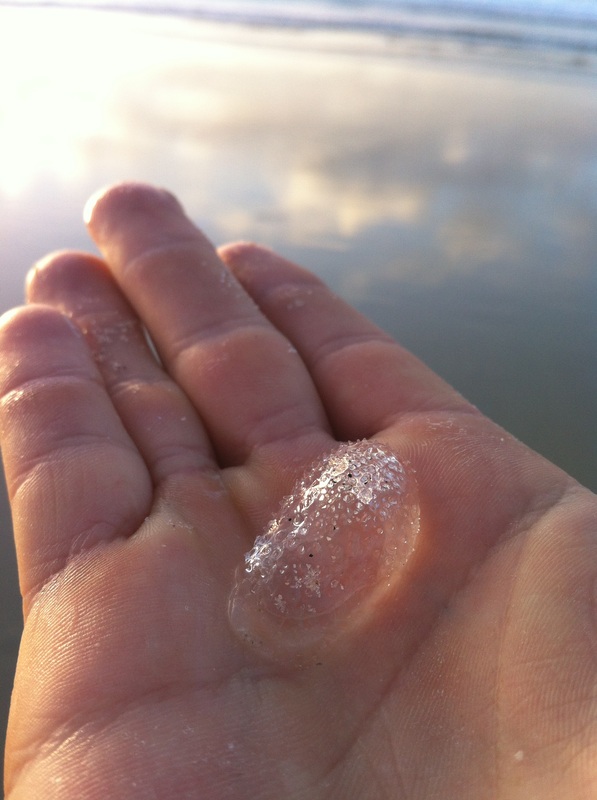
My best reenactment of the event, but with a manlier hand.
Shit.
You don't know what that is. You've seen it on the beach before, but you assumed you knew what it was. And by doing that, you just made an ass out of you and D.I.D. me. You were lazy, and no amount of guesswork can save you now. All of your defenses have been circumvented; a direct attack never came, you were sidestepped; by a little girl on a family trip to the beach you stopped going to.
Think man, think. No, this isn't happening... Some kind of algae...without pigment and gelatinous in the sun? Nice one, Monsieur Marine Biologist. Ok, so it's an animal then... A salp? Larvacean molt? Do those molt? And don't pteropods have shells? I've never seen one, so.. uh... Pyrosome? Shit, none of those are bumpy like this, it's not hollow, more like a thimble... Thimblosome? Note to self: copyright that later.... Umm, jeez, is it hot in here, or am I just embarrassed?... Wait wait hold on, give me a minute, I know what this is... OK, um... uh...
Suddenly, I was face to face with a glaring oversight in my defensive line. With all of my ammunition ready for what I had seen before, and my penchant towards knowitallness, I had forgotten my inability to patrol my own shoreline for weaknesses. It's all well and good if people storm the beaches and leave without knowing what they saw, it's another if they go looking for answers.
You don't know what that is. You've seen it on the beach before, but you assumed you knew what it was. And by doing that, you just made an ass out of you and D.I.D. me. You were lazy, and no amount of guesswork can save you now. All of your defenses have been circumvented; a direct attack never came, you were sidestepped; by a little girl on a family trip to the beach you stopped going to.
Think man, think. No, this isn't happening... Some kind of algae...without pigment and gelatinous in the sun? Nice one, Monsieur Marine Biologist. Ok, so it's an animal then... A salp? Larvacean molt? Do those molt? And don't pteropods have shells? I've never seen one, so.. uh... Pyrosome? Shit, none of those are bumpy like this, it's not hollow, more like a thimble... Thimblosome? Note to self: copyright that later.... Umm, jeez, is it hot in here, or am I just embarrassed?... Wait wait hold on, give me a minute, I know what this is... OK, um... uh...
Suddenly, I was face to face with a glaring oversight in my defensive line. With all of my ammunition ready for what I had seen before, and my penchant towards knowitallness, I had forgotten my inability to patrol my own shoreline for weaknesses. It's all well and good if people storm the beaches and leave without knowing what they saw, it's another if they go looking for answers.
I, uh. I don't know. That's a great question. Thank you for asking it. These tears are from the joy that I have in receiving such a stellar question. If you leave your contact info, I will be sure to send you an answer when I find one, as well as the terms of my surrender and the location of the rebel base.
This little girl, like so many Germans barreling through a supposedly impenetrable fortress of intellectual laziness, made quick work of my feeling of self-worth and went on to crush several more aquariumified minds before leaving, expecting an answer within a few days. She was a kind if ruthless invader.
The ensuing debate within the staff at the aquarium was telling of the disconnect "experts" and stewards of the coastline can be lulled into by the daily dose of drudgery surrounding full-time employment at a marine-science educational facility. You talk about the stuff all day long, you look at the ocean day-in and day-out, but the daylight is gone and the laundry isn't done when you're finally free to see what's changed out in the world. Eventually, if you aren't careful, your knowledge ceases to be exponential, or even linear. Left to its own devices, knowledge tends to go step-wise, via punctuated equilibrium: each disturbance raising the level up until the challenge is contained and assimilated, whereby you can finally go back to your peaceful life. Bliss (or ignorance, just spelled differently.)
The ensuing debate within the staff at the aquarium was telling of the disconnect "experts" and stewards of the coastline can be lulled into by the daily dose of drudgery surrounding full-time employment at a marine-science educational facility. You talk about the stuff all day long, you look at the ocean day-in and day-out, but the daylight is gone and the laundry isn't done when you're finally free to see what's changed out in the world. Eventually, if you aren't careful, your knowledge ceases to be exponential, or even linear. Left to its own devices, knowledge tends to go step-wise, via punctuated equilibrium: each disturbance raising the level up until the challenge is contained and assimilated, whereby you can finally go back to your peaceful life. Bliss (or ignorance, just spelled differently.)
There we go, all done learning that new thing. Now I don't need to learn anything ever again. That was fun, but I'm good now. I thought I knew everything before, but this is now, not then, and now I know I know everything. It's good to have reached the summit of all possible knowledge so young, I'll make a killing at trivia night.
Thankfully, these wake-up calls are usually jarring enough to force you to science-up and get knowing. Consultation with veterans of the coast and experts on gelatinous blobs from a nearby deep-sea research institute soon yielded the answer: Corolla sp. I got sea butterflies seeing the picture.
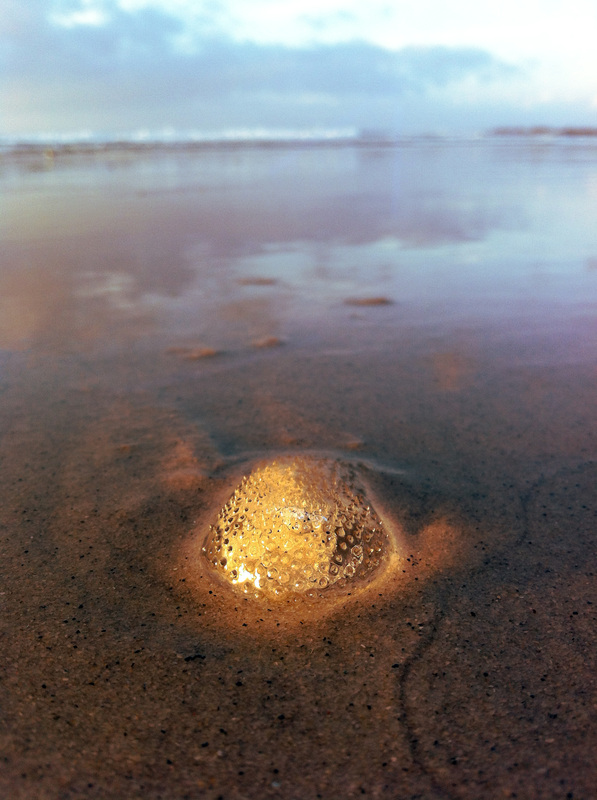
Corolla pseudconch parked on the beach, seconds before getting a ticket from Monterey Parking Enforcement.
Pteropods (aka sea butterflies) are hugely abundant pelagic snails, and an important component of the "jelly-web", a mostly overlooked portion of the ocean's denizens. Although gelatinous creatures - like pteropods, siphonophores and salps, to name a few - may compose over 50% of the biomass of the sea, we don't care because they don't have backbones and we don't eat them (directly).
Pteropods like Corolla, however, are the potato chips of the sea. Like krill, anything with a mouth big enough is eating pteropods, or stuff that eats pteropods. They are also some of the most vulnerable ocean critters to the dangers of ocean acidification, and yet you never give them a second thought on your morning commute.
Pteropods like Corolla, however, are the potato chips of the sea. Like krill, anything with a mouth big enough is eating pteropods, or stuff that eats pteropods. They are also some of the most vulnerable ocean critters to the dangers of ocean acidification, and yet you never give them a second thought on your morning commute.
"Shameful" - Guy using a computer plugged into the wall and connected to the Internet.
The blobs on the beach are called pseudoconchs, which have replaced the calcareous shells that other pteropods possess. This tough piece of marine jelly is all that is left of a feast happening at sea, unseen from shore, where hordes of sea butterflies flitter about before being consumed by millions of hungry mouths looking for some comfort food.
The young girl received her answer, and she pardoned me for my transgression against the pursuit of knowledge. I had learned my lesson. And so I monitored the beaches for a different kind of wash-up; conferring with my colleagues told me to expect a few more mass-strandings from this seasonal nearshore feeding frenzy within sight of the office. A few weeks later, and I saw what I was hoping to see on the beach flanking the marine science campus next door.
The young girl received her answer, and she pardoned me for my transgression against the pursuit of knowledge. I had learned my lesson. And so I monitored the beaches for a different kind of wash-up; conferring with my colleagues told me to expect a few more mass-strandings from this seasonal nearshore feeding frenzy within sight of the office. A few weeks later, and I saw what I was hoping to see on the beach flanking the marine science campus next door.
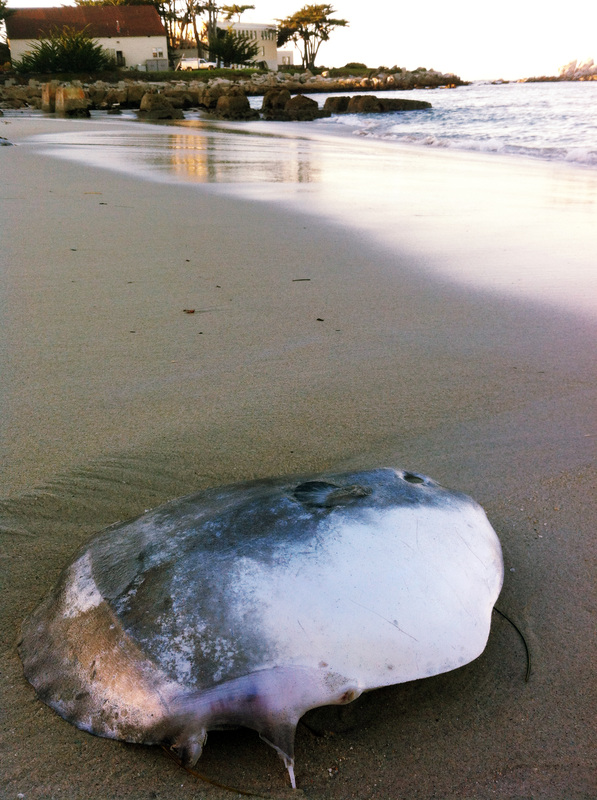
Bummer, bro.
Ocean sunfish. Mola mola. The heaviest bony fish in the sea, weighing in at a ridiculous 5,000 lbs fully grown, these fish go through a 60 million-fold increase in body weight from birth to full size. That's like a human baby born at 8 lbs, and weighing 240 000 tons, or two aircraft carriers, fully grown. A true heavyweight of the bay.
Hey mom, can you take me to the grocery store? I need to eat it.
Except not this one. No, this one, along with a myriad of its dinner-plate-sized comrades were ruthlessly torn apart just offshore by boisterous otariids that so nearly were the mascot of my alma matter. In the late summer and fall, thousands if not tens of thousands of juvenile molas travel with the currents within sight of the coast to feed on a host of gelatinous fare. From jellies to salps to pteropods, sunfish are looking to bulk up quickly to get to a size where no one will mess with them, and the fall has plenty of gelatinous snacks and pseudoconch-clad munchies to boost them above that magic threshold. Like how I waited all through middle school for the growth-spurt that would put me into the safe zone.
But, sadly, California sea lions (Zallophus californianus) are those glandular inbreds that prey on you until you're not worth the effort. These dinner-plate sized sunfish are ruthlessly torn apart, dorsal and anal fins first, to get at the meat at their bases, and sometimes to devour the liver of the young mola. The rest of the fish, a thick mass of skin and parasites (40+ species, so much so their parasites have parasites), is essentially inedible. So, in a case of down-the-food-chain bullying, the sea lions took a page out of the book orcas wrote on eating pinnipeds: they toss the sunfishes' still-breathing husks about like Frisbees. Others will even skip them like stones. I saw one sea lion achieve a triple skip of a young mola, a tragically impressive feat.
But, sadly, California sea lions (Zallophus californianus) are those glandular inbreds that prey on you until you're not worth the effort. These dinner-plate sized sunfish are ruthlessly torn apart, dorsal and anal fins first, to get at the meat at their bases, and sometimes to devour the liver of the young mola. The rest of the fish, a thick mass of skin and parasites (40+ species, so much so their parasites have parasites), is essentially inedible. So, in a case of down-the-food-chain bullying, the sea lions took a page out of the book orcas wrote on eating pinnipeds: they toss the sunfishes' still-breathing husks about like Frisbees. Others will even skip them like stones. I saw one sea lion achieve a triple skip of a young mola, a tragically impressive feat.
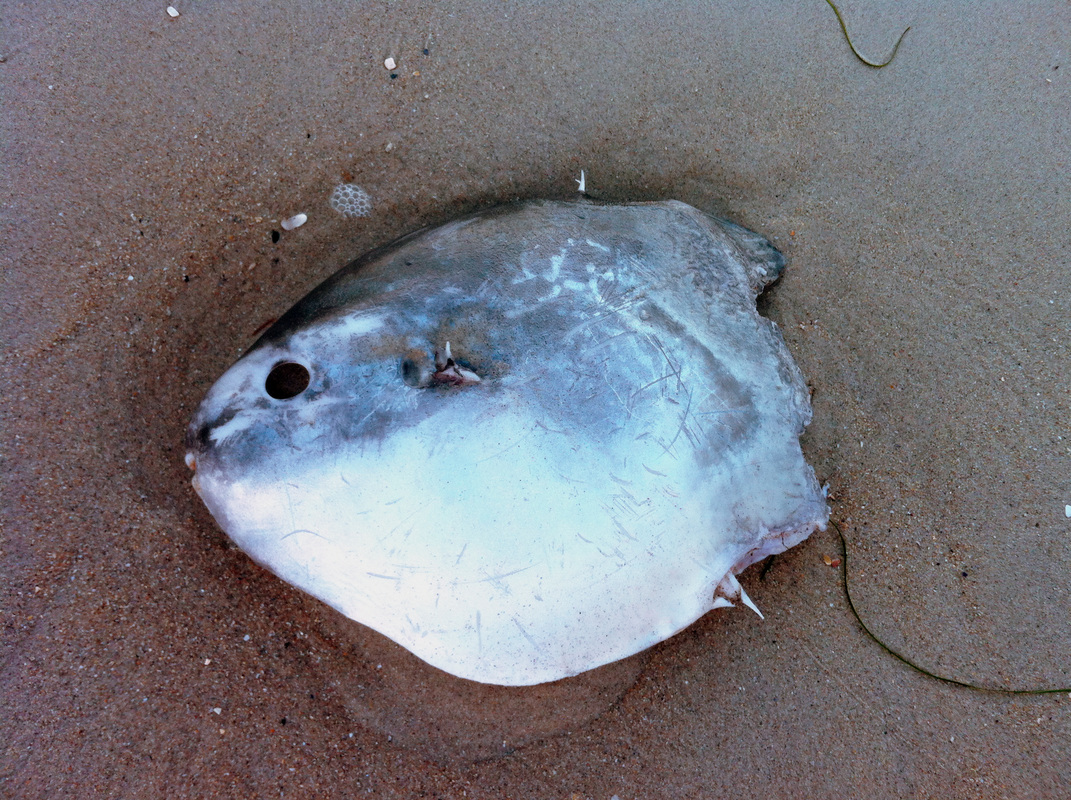
Mola, in repose.
The sea lions were there for the sunfish. The sunfish were there for the pteropods. The pteropods were there to teach me a lesson. Beyond simply reemphasizing the priority going to the ocean's edge and diving under the waves should hold in a marine biologist's life, these gelatinous blobs showed me how easily one can stagnate and become infatuated with their adequate but unchanging knowledge base. I've renewed my vows to the sea to continue the visits, but with more stringent expectations of constant questioning and follow-up.
A simple question and ubiquitous pelagic snails humbled me deeply many months ago. Though "What's this?" has been the mantra that led to this website in the first place, asking it more frequently of myself took me back to a place on the highway of scientific learning where my knowledge can grow continually again.
To get to this particular place, however, I wasn't at the wheel. Just like the sea lions and the sunfish weren't running the show, I'm following the lead of the thimblosomes. As Groucho Marx would have put it:
A simple question and ubiquitous pelagic snails humbled me deeply many months ago. Though "What's this?" has been the mantra that led to this website in the first place, asking it more frequently of myself took me back to a place on the highway of scientific learning where my knowledge can grow continually again.
To get to this particular place, however, I wasn't at the wheel. Just like the sea lions and the sunfish weren't running the show, I'm following the lead of the thimblosomes. As Groucho Marx would have put it:
In Soviet Russia, Corolla sp. drives you.
- Patrick Anders Webster, 02/13
* "Fat" in French refers to something/someone who is "pretentious without much inherent worth". I was told to look up the meaning of this word (along with "arrogant", "conceited" and other aptly picked vocabulary) by my 8th grade French teacher Mr. Rust, and reflect on how they applied to my person after I called him out for grading favoritism towards the French students. I never actually looked it up until today, but it seemed like the perfect place to finally use the word. Merci Mr. Rust!
* "Fat" in French refers to something/someone who is "pretentious without much inherent worth". I was told to look up the meaning of this word (along with "arrogant", "conceited" and other aptly picked vocabulary) by my 8th grade French teacher Mr. Rust, and reflect on how they applied to my person after I called him out for grading favoritism towards the French students. I never actually looked it up until today, but it seemed like the perfect place to finally use the word. Merci Mr. Rust!
 RSS Feed